
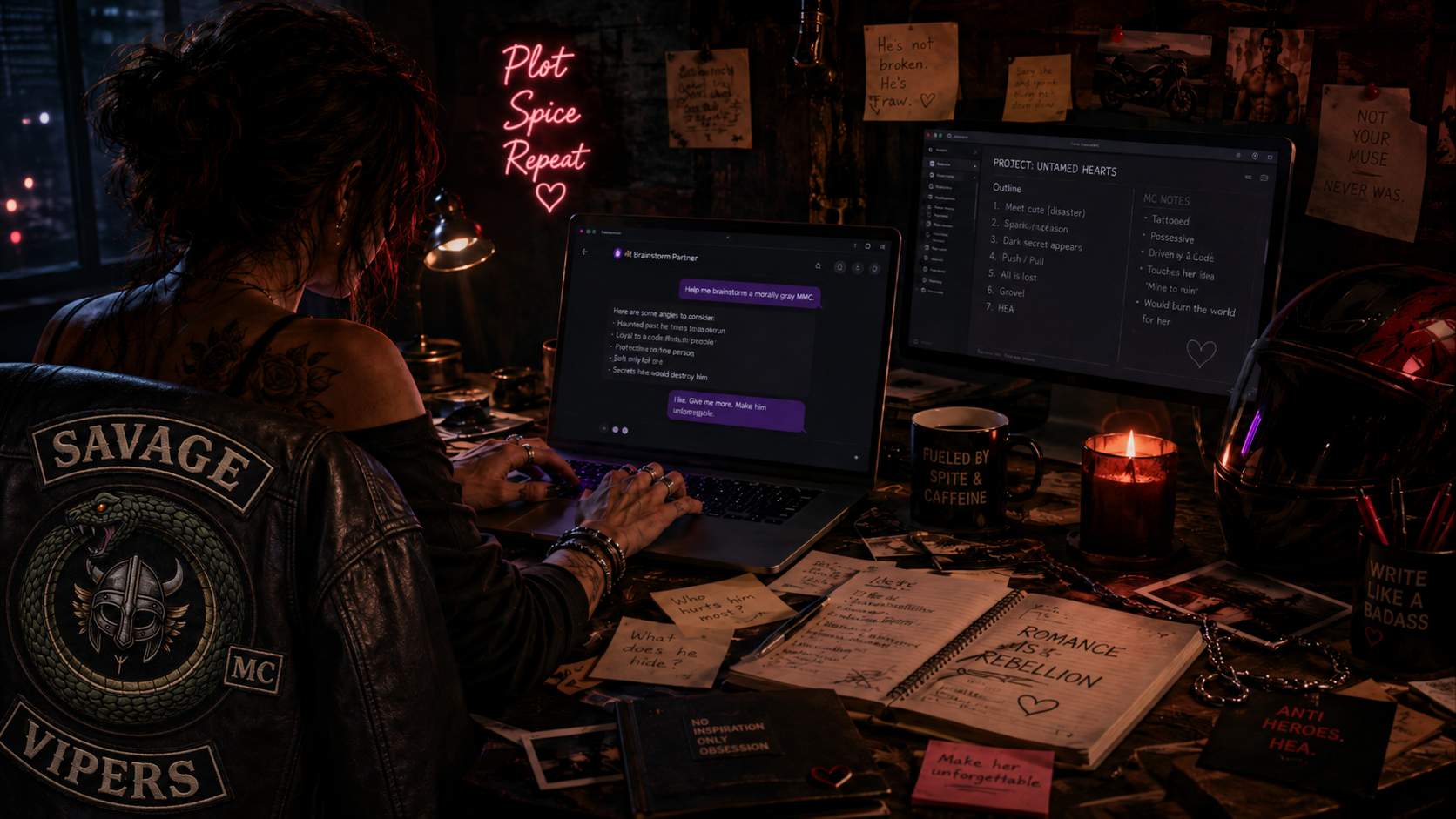
I’ve gotten shit for using AI to help me write.
I’ve had people imply — or flat-out say — that because I use AI in any capacity, I’m not a “real writer.”
Yeah, well, that’s cute.
It’s also bullshit.
Because the people saying that don’t know my process. They don’t know my brain. They don’t know my characters. They don’t know the hours I’ve spent untangling plot threads, researching real-world details, building emotional arcs, revising chapters, questioning every fucking decision, and trying to make sure the story on the page matches the story clawing around inside my head.
So let me be painfully clear.
AI did not write my book.
I did.
AI didn’t create Monster.
AI didn’t create Rylee.
AI didn’t give me the Savage Vipers.
AI didn’t build the trauma, the danger, the found family, the loyalty, the fear, the heat, or the emotional damage wrapped around these characters.
That shit came from me.
AI is a tool.
That’s it.
And if using a tool means I’m not a “real writer”, then somebody better go tell every author using spellcheck, Grammarly, Scrivener, ProWritingAid, Google, Pinterest boards, critique partners, beta readers, editors, writing craft books, caffeine, playlists, and emotional support snacks that they’re apparently frauds too.
Because where exactly are we drawing the line?

AI Can’t Do Shit Without an Idea
The first thing I want to make clear is this:
AI can’t do a damn thing without an idea.
Plain and fucking simple.
It can’t give me anything useful if I don’t know what kind of story I’m trying to tell. It can’t build a romance if I don’t know who the couple is. It can’t create emotional conflict if I don’t know what broke these people. It can’t give Rylee a reason to run if I haven’t already figured out what scared her badly enough to leave everything behind.
The spark still has to come from a creative brain.
That’s mine, baby.
Before AI ever gets involved, there is a shit ton of work already happening.
And for me, that work starts in the most beautifully chaotic way possible.

I Start With a Word Vomit Document
My first step is what I lovingly call my word vomit document.
And yes, it is exactly what it sounds like.
Everything goes in there.
Every random thought. Every character whisper. Every half-formed scene. Every line of dialogue that hits me while I’m doing dishes or driving or trying to fall asleep. Every little thing Monster growls in the back of my head. Every fear Rylee carries. Every tiny Hailey moment that makes me laugh, cry, or want to throw my laptop across the room.
None of it is in order.
Not even a little.
It’s a disaster.
But it’s my disaster.
And for my ADHD brain, that document is fucking gold.
Because if I leave all those ideas rattling around in my head, they don’t politely wait their turn. They start multiplying. They bounce off each other. They turn into seventeen new ideas, six future books, three spin-offs, and one random side character who suddenly wants a redemption arc.
Getting the chaos onto the page gives me something I can actually work with.
It lets me breathe.
It lets me look at the mess and start asking, Okay, what the hell is this really about?
That word vomit document is always open. It grows as I go. New ideas get dropped in there constantly. Scenes I can’t shake get written out before I know where they belong. Future book ideas get shoved in there too, even when I know my ass needs to focus on the book I’m currently writing.
This is also why I feel like my whole process is dysfunctional without multiple monitors.
My brain wants every damn thing visible at once.

Then I Figure Out What Genre Promises I’m Making
Once I have the beginnings of the word vomit document, I usually know the genre and subgenre.
With Savage Redemption, I knew right away that Monster and Rylee belonged in a bigger MC romance world.
My brain immediately started shitting out ideas for future books, rival clubs, spin-offs, side characters, betrayals, family secrets, and all kinds of dramatic bullshit I had no business planning yet.
That was the ADHD talking.
And I had to tell it to sit the fuck down.
Because before I could worry about book two, book four, or some rival club president who might not even exist yet, I needed to understand book one.
I needed to know what readers expect from MC romance.
Are the books usually standalone?
Do they have an overarching plot?
How much club business is too much?
How much romance needs to stay front and center?
What emotional promises am I making to the reader?
Because genre matters.
Every genre comes with expectations.
Nobody picks up a romance novel expecting it to suddenly turn into Rambo with no relationship payoff. Sure, romance can have danger. It can have violence. It can have crime, suspense, trauma, blood, betrayal, motorcycles, guns, clubs, enemies, bad decisions, and morally questionable men with filthy mouths and possessive tendencies.
But at the core?
Romance readers want the couple.
They want the emotional conflict.
They want the tension.
They want the heat.
They want the payoff.
They want the happily ever after, or at least the happy for now.
And if they’re my readers?
They probably want a lot of smut wrapped around the emotional damage.
So I made another document.
This one is more research-based. It’s where I dig into the “requirements” of my genre. Not because I want to write by some boring-ass formula, but because I want to understand the promises I’m making.
Readers come to certain genres for a reason.
My job is to give them what they came for, then make it mine.

Then Comes the Real-World Rabbit Hole
The next document is research specific to my story.
Because real life is fucked up, and I want my fiction to feel like it has bones underneath the drama.
For Savage Redemption, that meant researching things like motorcycle clubs, law enforcement pressure, RICO cases, criminal enterprise investigations, trauma, custody fears, domestic violence patterns, survival behavior, and all the messy real-world shit that gives a fictional story weight.
I’ve seen RICO mentioned on TV and in movies plenty of times.
But at some point, I had to stop and ask:
What the fuck is RICO, actually?
Has it been used against motorcycle clubs?
How does law enforcement go after an MC they believe is a criminal enterprise?
What does that look like beyond Hollywood bullshit?
One question becomes ten.
Ten becomes fifty.
Then suddenly I’m down a rabbit hole at midnight with too many tabs open, muttering, “Well, fuck, that changes things.”
For this part of the process, I use Scrivener.
The binder feature helps me organize the chaos into sections. Research. Character notes. Worldbuilding. Club structure. Legal details. Scene ideas. Anything I might need later.
Does it fully organize my brain?
No.
Let’s not get crazy.
But it helps.
And when your brain is juggling a whole fictional world, “helps” is enough to keep you from screaming into the void.

Then, Finally, I Bring In AI
Once I have the word vomit document, the genre research, and the story-specific research, then I bring AI into the process.
Not to write my book.
To help me think.
There’s a difference.
I’ll drop in my notes and ask questions. I’ll ask AI to help me find patterns. I’ll ask it to look at character motivation. I’ll ask it to answer from a character’s point of view. I’ll ask it what emotional conflict might be missing or where the outline feels thin.
AI can read a giant pile of chaotic notes in minutes.
That’s useful as hell.
But it’s not magic.
And it sure as shit isn’t perfect.
Sometimes AI gives me gold.
Sometimes it gives me bland, generic crap that sounds like it was written by a committee of beige office furniture.
Sometimes it misses the entire damn point.
Sometimes it forgets who the characters are, flattens the emotion, softens the conflict, or tries to make my morally gray characters behave like they belong in a team-building seminar.
That’s when I correct it.
Because I’m still the writer.
I’m still the one deciding.
I’m the one picking the gold out of the pan and throwing the rest of the dirt back where it belongs.

AI Helps Me Organize My Brain
A lot of my AI use is about structure.
I use prompts to help develop my series bible, story bible, worldbuilding, character profiles, relationship arcs, and revision maps. Some of those prompts came from the Story Hacker community, which has been helpful as hell for learning how to use AI without handing over creative control.
But again, AI doesn’t get final say.
I do.
The story bible is the big document. The beast. The “holy shit, this world has a lot of moving parts” document.
It tracks characters, backstory, club dynamics, emotional wounds, relationship arcs, future seeds, setting details, and all the shit I need to remember so I don’t accidentally contradict myself three chapters later.
And because my brain likes to run in six directions at once, having AI help me shape that information into something usable is a big damn deal.
I spent ten years doing this with pen and paper.
Ten years.
So yeah, I’m going to use the tool that helps me organize the mess faster.
I’m not sorry about that.

The Outline Still Has to Be Mine
Eventually, once Monster is yelling at me to move my ass, I ask AI to help turn the chaos into a workable outline.
But even then, I don’t just accept whatever it gives me.
Hell no.
This is a book with my name on it.
So I read the outline. I question it. I tweak it. I move things. I delete things. I add the pieces that feel right. I fix the emotional beats that don’t hit hard enough. I make sure the story is actually going where I want it to go.
Then I may ask AI to clean up the structure again.
After that?
I let it sit.
At least a few weeks.
I’ll read a book. Play a video game. Watch something. Do anything except stare at the outline until I hate it.
Then I come back with a fresh brain and read it again, praying no major plot hole jumps out and slaps me in the face.
If it still feels solid, then I write.

Yes, I Still Write the Rough Draft
This part seems to confuse people, so let me say it again:
I write the rough draft.
Me.
My hands.
My brain.
My characters.
My choices.
My emotional damage.
If I get blocked, yes, sometimes I ask AI questions. Not because I need it to write the book for me, but because sometimes I need something to bounce against.
Some writers talk to friends.
Some talk to critique partners.
Some talk to their pets.
Some stare dramatically out windows.
I ask AI questions, argue with half the answers, and keep moving.
Once the rough draft is done, I revise.
Because no rough draft is pretty.
No one is out here producing a flawless first draft while woodland creatures braid their hair and sing them motivational songs.
Rough drafts are ugly.
They’re supposed to be.
That’s where the story exists before it becomes good.

Revision Is Where the Real Work Kicks My Ass
After the rough draft, I go back through and fix what I already know needs fixing.
Continuity issues.
Missing side characters.
Emotional beats that don’t land.
Scenes that need more tension.
Chapters that drag. Sometimes that means a whole chapter rewrite.
Places where future book threads need to be planted.
Moments where the romance needs more heat, more ache, more bite.
Then I let the manuscript sit again.
Usually at least a month.
That advice comes from Stephen King’s On Writing, and honestly, it makes sense. You need distance from the manuscript before you can see the problems clearly.
During that break, I’ll usually start brainstorming the next book. Not drafting it necessarily, but figuring out what pieces from book two need to be seeded in book one.
Because series writing is a bitch like that.
You think you’re writing one book, and suddenly the next book is standing in the corner like, “Hey, remember me? Better set up my trauma now.”
Once I come back to the manuscript, I make those changes too.
Then I may ask AI for a revision map.
Again, not because AI is in charge.
Because I want another layer of structure.
I go through the revisions using a combination of the map, my instincts, and the deep gut-level feeling of, No, this scene still isn’t fucking right.

AI Can Be a Beta Reader Too
At some point, I’ll also ask AI to read the book like a beta reader.
Some writers have big critique circles.
Some have trusted readers.
Some have editors on standby.
Some of us are still building that part of the process and need a little impartial feedback before handing the book to someone we love and asking them to rip our soul apart.
AI can help with that.
It can flag pacing issues.
It can point out unclear motivations.
It can catch continuity problems.
It can tell me when a chapter feels weaker than the others.
Do I agree with everything?
No.
Absolutely fucking not.
But sometimes it gives me enough distance to see the work more clearly.
And that matters.

This Is Still My Book
Right now, I’m still in the revision process for Savage Redemption.
This is the first book where I’ve fully made use of AI as part of my process, and honestly?
It feels like a partnership.
Not a replacement.
AI helps me organize.
AI helps me brainstorm.
AI helps me ask better questions.
AI helps me see the mess from another angle.
But I keep creative control.
Always.
AI did not generate my book.
I came up with the idea.
I built the characters.
I did the research.
I wrote the scenes.
I made the choices.
I shaped the outline.
I revised the chapters.
I decided what stays and what gets cut.
And when this book goes out into the world, my name is the one on the cover.
Because it’s my fucking story.

So Who Cares How the Story Got in Your Hands?
I may use AI to help me edit.
I may use it to help with marketing.
I may even use it to help me brainstorm cover ideas.
I’m still figuring that part out.
Because I’m going to be honest: I’m not sitting here pretending my smut is guaranteed to pay all my bills. I write because I love a good story. I write because these characters won’t leave me alone. I write because romance, danger, loyalty, found family, trauma, healing, and filthy heat are the kinds of stories I want to tell.
And if someone else enjoys them?
That’s fucking amazing.
So at the end of the day, who cares how the story got in your hand?
Was it good?
Did it make you feel something?
Did you stay up too late reading?
Did you fall for the characters?
Did you yell at them?
Did you need a cold drink after the spicy scenes?
Then the story did its damn job.
AI didn’t write my book.
I fucking did.
